Who’s Screaming Now? Inside Horror’s Changing Audience


KEY INSIGHTS
- In the period studied, 67% of horror moviegoers were adults 18–34, compared with 61% of moviegoers overall.
- Data also confounds myths around horror audiences being mostly male, with an even 50/50 gender split for the genre.
- A closer look at horror subgenres pinpoints which appeal the most to an 18–34 old cohort (psychological horror) VS. a 55+ demographic (vampire films).
-
Good news for ghouls, freaks, the undead, and people lost in endless yellow hallways: horror is drawing an audience that defies many familiar assumptions. Its moviegoers skew younger than those of any other genre in our analysis, are evenly split between men and women, and vary considerably depending on the kind of scares on offer.
That makes horror increasingly valuable for networks, exhibitors, brands, and marketers. And of course, understanding who shows up — and which films they show up for — is more useful than treating horror fans as a single, monolithic audience. The scale of the opportunity is substantial. Close to 400 million movie tickets were sold during the period covered by Numetrix’s analysis (January–July 2026); nearly 30% were for a horror film.
If you were to rank every movie that has premiered this year so far, three Horror titles make it into the top 10 (“Obsession” at #5, “Backrooms” at #6, and “Scream 7” at #10).
Horror’s stylistic range helps explain why it is worth looking beyond a single audience profile. Alongside jump scares, established franchises, and Halloween-season releases, the category incorporates social commentary, psychological drama, comedy, nostalgia, and internet culture.
But those different forms of horror don’t all attract the same crowd. Our data shows where the audiences differ, and where the stereotypes fall apart.
Horror Reaches a Young Audience, Attractive to Advertisers
Horror is increasingly valuable to the theatrical ecosystem because it over-indexes with younger moviegoers. In the period studied, 67% of horror moviegoers were adults 18–34, compared with 61% of moviegoers overall, making the genre particularly attractive to advertisers looking to reach younger, culturally engaged audiences.
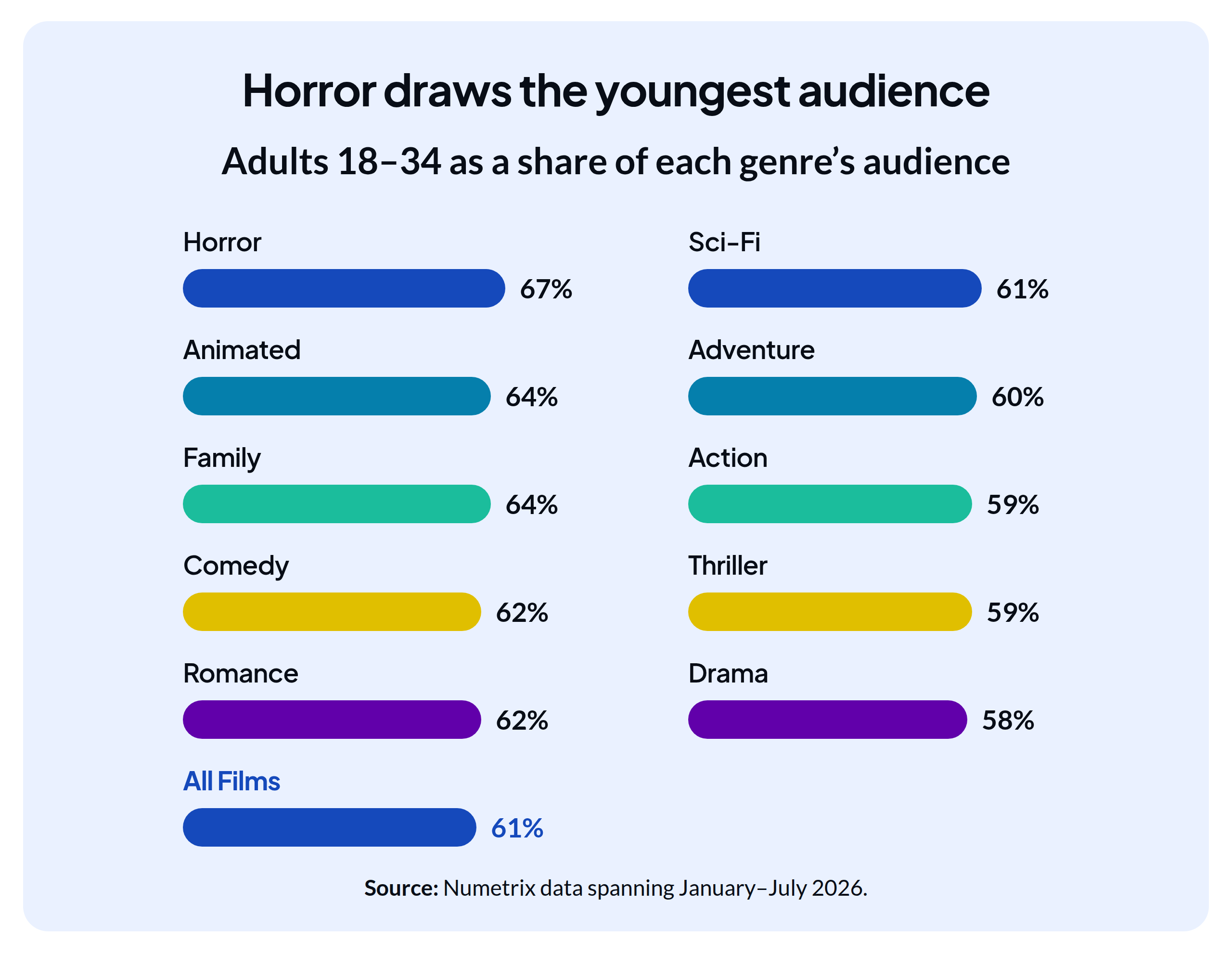
In fact, horror is the youngest-skewing category in our analysis, ahead of animated and family films at 64% each, and comedy and romance at 62% each.
For advertisers looking to reach younger adults, that six-percentage-point difference matters. Horror offers a higher concentration of 18–34-year-olds than the moviegoing audience overall.
And as the subgenre data shows, some kinds of horror offer an even more pronounced young-adult skew.
Breaking Down Horror’s Young Adult Audience
Certain horror subgenres skew even more strongly toward the 18–34 demographic. While younger adults still show up for slasher movies, they account for a greater share of the audience for liminal/media, psychological, and sci-fi horror.
Adults 18–34 make up 75% of the psychological horror audience and 74% of both the liminal/media and sci-fi horror audiences. Horror comedy is close behind at 72%. All four exceed both horror’s 67% average and the 61% benchmark for moviegoing overall.
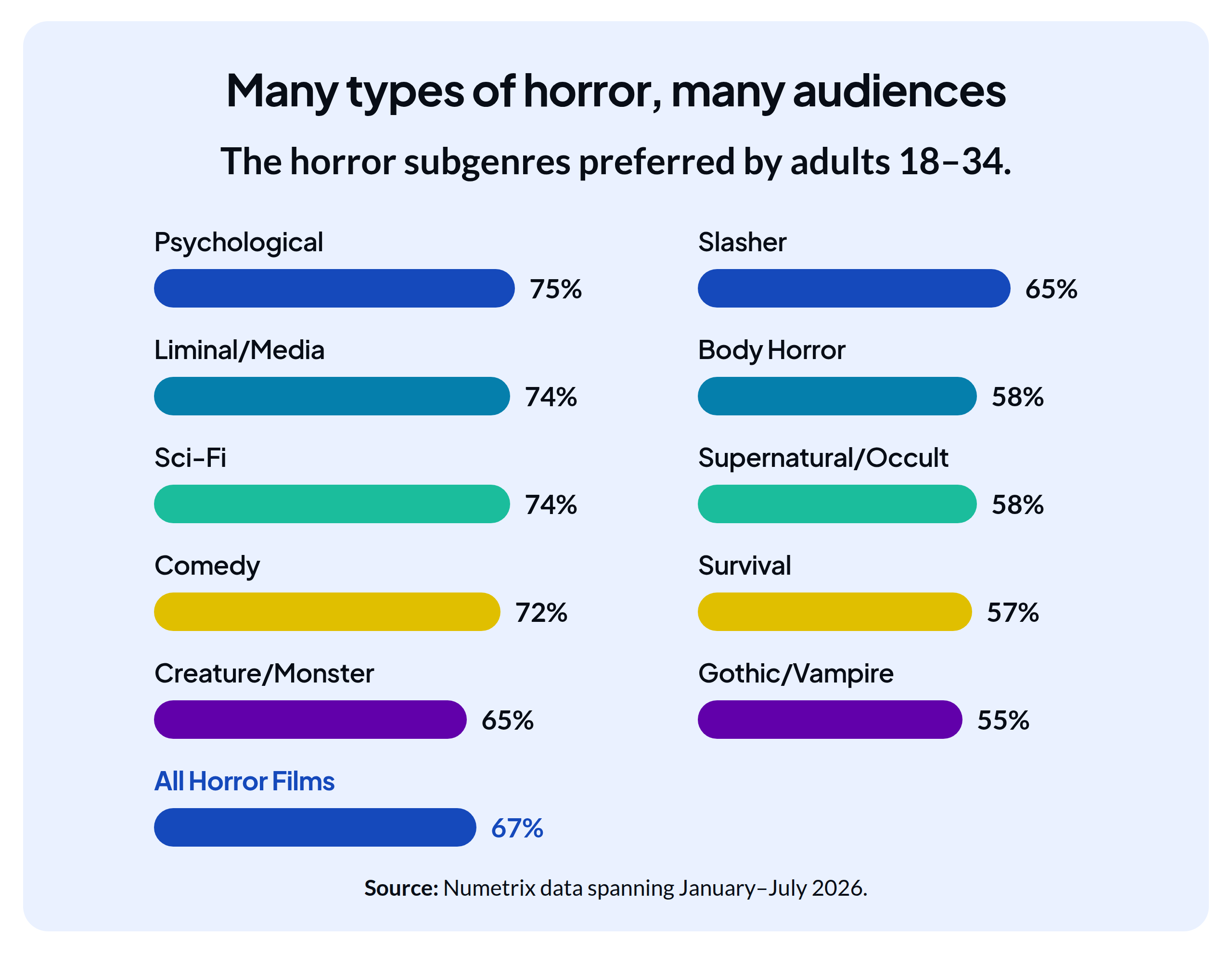
The range is revealing. Young adults account for three-quarters of the psychological horror audience, but just over half of the gothic/vampire audience. Slasher and creature/monster films sit between those extremes, with 18–34-year-olds making up 65% of each audience.
For a brand prioritizing young-adult reach, those differences offer a more specific starting point than the horror label alone.
Traditional Scares Find an Older Audience
The horror genre may under-index among older audiences, but there’s an interesting dynamic once you look into subgenres. Some more traditional forms of horror attract a greater share of adults 55+ than either horror overall or the general moviegoing population.
Adults 55+ make up 9% of the horror audience, compared with 11% of moviegoers overall. For vampire films, that share rises to 15%; supernatural/occult and survival horror each reach 13%.
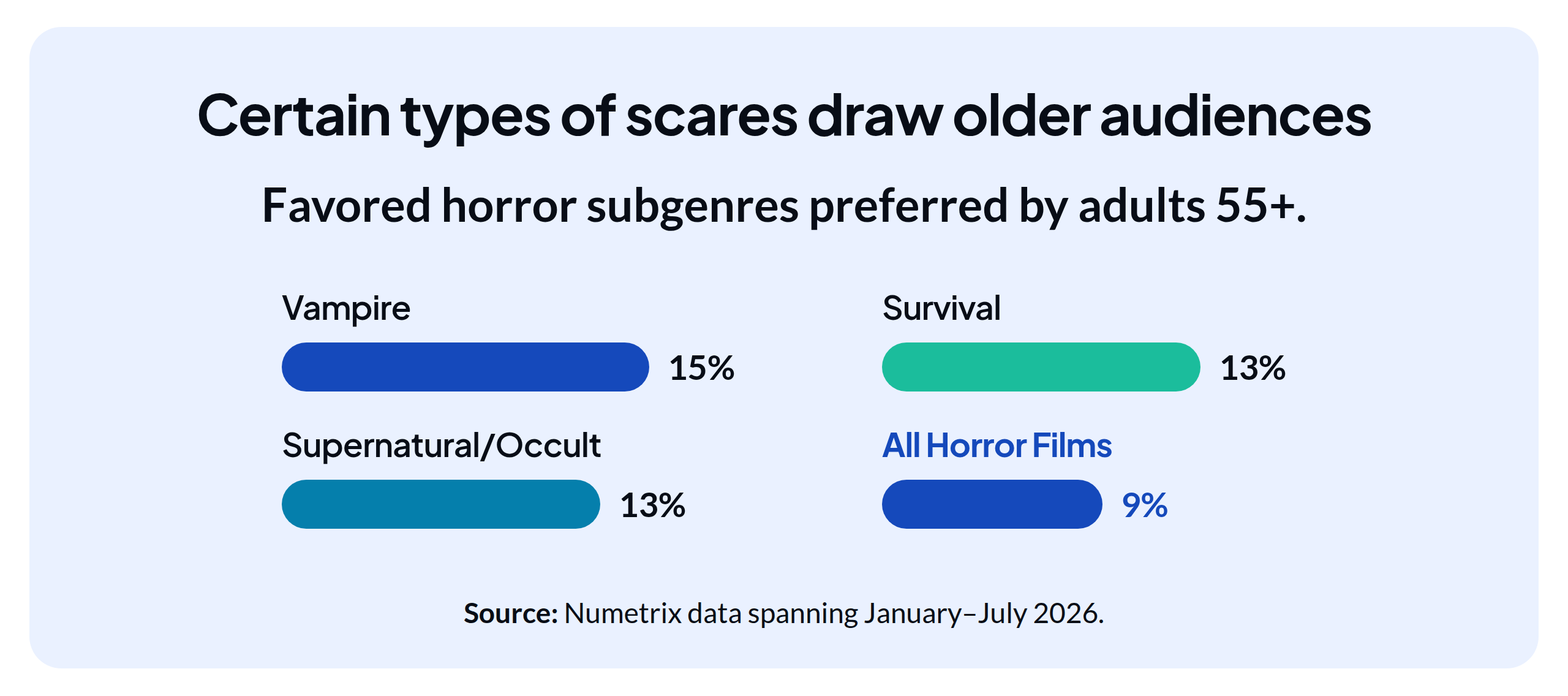
Older audiences haven’t been frightened off. Their representation just varies with the type of film. Supernatural/occult and survival horror, for example, both fall below the all-film benchmark for adults 18–34, while exceeding it for adults 55+.
For exhibitors and marketers, that is a reason to look beyond horror’s youthful reputation. A campaign aimed at older moviegoers needn’t rule out horror, but it should be mindful of the subgenres that attract the demographic.
Only Men are Real Horror Fans, Right? Think Again.
Switching gears from age to gender, Numetrix’s data helps dispel another myth about horror audiences. You could be forgiven for assuming that the horror boom is being driven primarily by male moviegoers. That’s just not true.
While total cinema audiences tend to be closely split between men and women, horror is the only genre in our analysis that is completely evenly split: 50/50, compared with 51/49 for moviegoing overall.
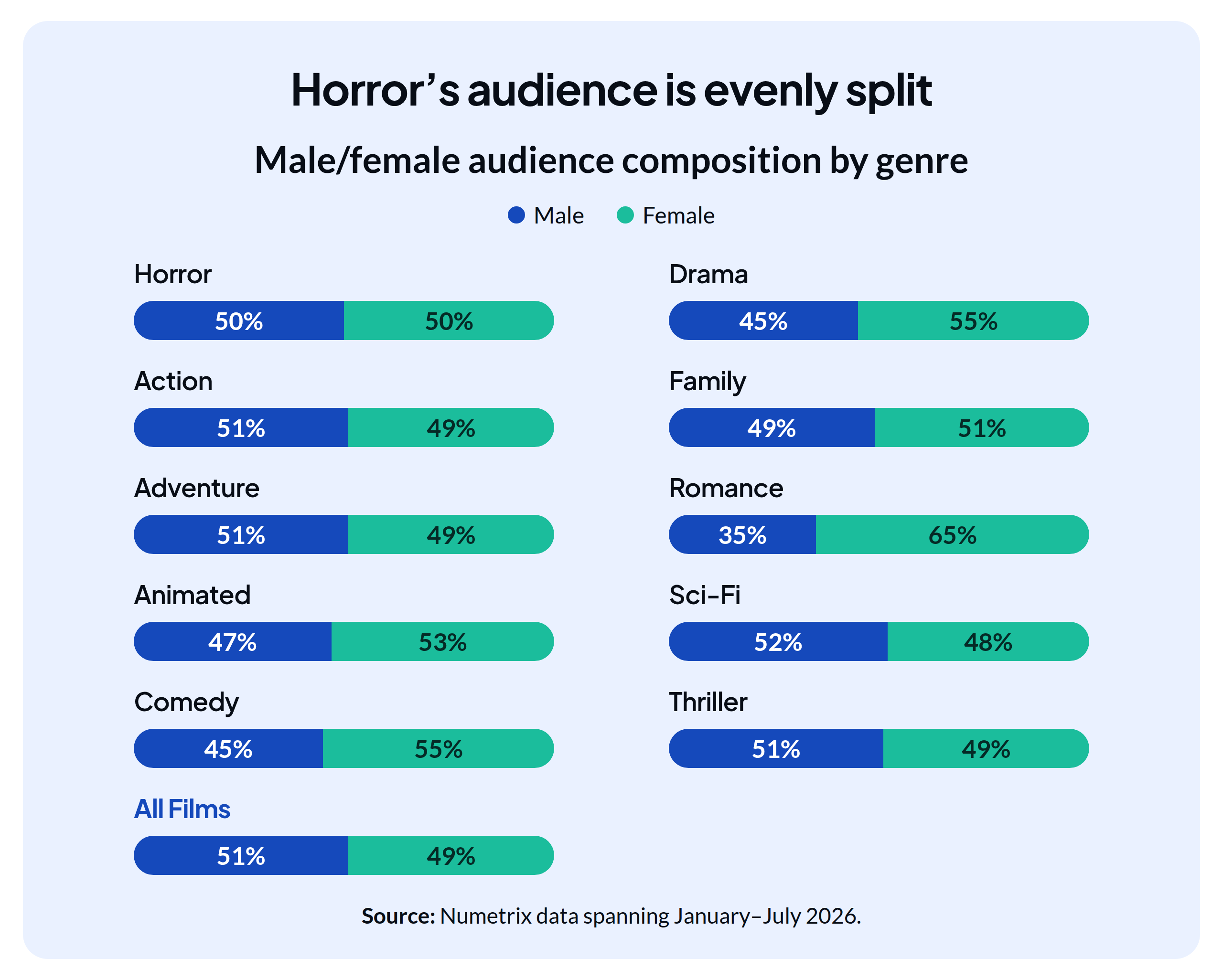
That challenges the idea that horror is a predominantly male advertising environment. Brands and marketers shouldn’t mistake the genre’s subject matter for a reliable guide to the gender of the people buying tickets.
That said, look more closely and the balance changes. Body horror does skew heavily male, with an 80/20 split. Liminal/media horror is much closer to even at 52/48, while slasher films are only slightly more male at 51/49.
The distinction is important: Horror’s overall audience is balanced, but that doesn’t mean every horror audience is. Planning around the specific subgenre, rather than a general notion of the “typical horror fan,” can produce a more relevant audience match.
The person snapping up a ticket to a liminal/media title (like “Backrooms”) may not have much in common with someone drawn to body horror (like “Slanted”).
Beyond Halloween: Audiences Show Up Throughout the Release Calendar
While horror used to be closely associated with Halloween and “spooky season,” it’s now an evergreen opportunity to reach moviegoers well beyond October. The period covered by Numetrix’s analysis included major studio franchise entries, breakout originals, and digitally fueled hits, giving audiences different reasons to return to theaters throughout the year.
Nearly every month in the first half of 2026 included a horror release, often opening within the top few spots of the weekend’s box office. January saw “Primate,” “Send Help,” and “28 Years Later,” all opening at either the #1 or #2 spot. February had “Psycho Killer” and “Scream 7.”
Move into March and you’ll find “The Bride” and “Ready or Not 2: Here I Come.” Q2 2026 brought “Hokum,” the runaway hit “Obsession,” and “Evil Dead Burn.” And these titles have staying power, with many remaining in the top 10 box office rankings for multiple weeks.
The audience implication is straightforward: horror is no longer a seasonal marketing opportunity. Exhibitors and cinema networks can plan around a range of releases outside the Halloween window, while brands can look for the titles and subgenres whose audiences best fit their campaigns.
The Value is in Knowing Who’s Watching
There’s a lot to be said about the horror genre’s creative explosion in recent years — the diversity of scary stories that are being told, and how horror films create a sense of shared, communal experience. But for our purposes here, the main takeaway is about who is filling these seats: the combination of an overall young audience, an even male/female split, and meaningful differences beneath the genre label.
For networks and exhibitors, those differences can help inform how releases are positioned and which audiences to address. For brands and marketers, they offer a basis for selecting relevant theatrical environments rather than relying on assumptions about who likes to be scared by the increasingly broad category of “horror” films.
The data doesn’t point to one definitive horror fan. It points to several niche audiences: a particularly young crowd for psychological, liminal/media and sci-fi horror; an older-skewing audience for vampire films; and a gender balance that can look very different from one subgenre to the next.
Horror presents a scarily good opportunity in this regard, and our data clearly shows the value of investing in reaching an audience that is much more eclectic than it once was.